
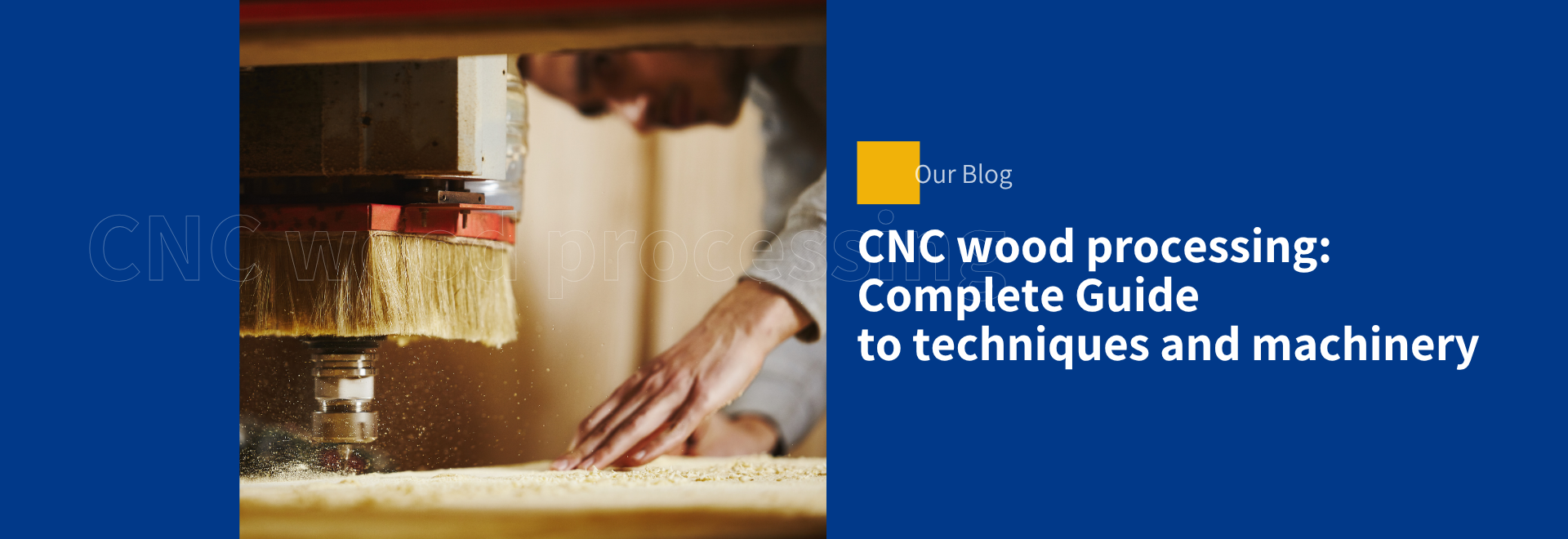
CNC woodworking has become a key reference point for those working in joinery and industrial production. Computer Numerical Control has made it possible to perform cutting, milling, drilling and carving operations with millimetric precision, reducing production times and significantly lowering the risk of errors.
Table of contents
- What CNC is and why it has changed the woodworking sector
- How CNC machine programming works
- The main types of CNC woodworking operations
- Advantages of numerical control machining in the woodworking sector
- Materials that can be processed with CNC machines in the woodworking sector
- How to choose the right CNC machine for your production
- Software and programming for CNC woodworking
- Practical applications: where CNC woodworking is used
- How to optimize production with CNC machines
- Bringing CNC precision into your production
What CNC is and why it has changed the woodworking sector
CNC stands for Computer Numerical Control. In simple terms, it is a system that guides the movements of a machine tool through digital instructions generated by dedicated software — without the operator having to intervene manually during the execution of the operations.
In the past, working on a piece of wood meant physically following every step, with all the time and variability this involved. With a CNC machine, the program is set up once and then replicated hundreds of times with identical results. This qualitative leap has transformed the way production is carried out in the sector.
How CNC machine programming works
The starting point is the digital design of the workpiece using CAD software (Computer-Aided Design). The file is then processed by CAM software (Computer-Aided Manufacturing), which translates the drawing into a concrete toolpath: a sequence of coordinates and instructions known as G-code.
From that point on, the woodworking machine CNC operates autonomously. The operator supervises the process and intervenes when necessary — for adjustments or tool changes — but the production cycle continues without interruptions, maintaining the same quality regardless of the complexity of the workpiece.
The main types of CNC woodworking operations
Talking about CNC woodworking processes does not mean referring to a single operation. Rather, it involves a set of different techniques, each suited to a specific purpose. The most common in the sector are milling, cutting, drilling, pantographing and engraving — often combined on the same workpiece within the same cycle.
CNC milling
Among all CNC processes, milling is probably the most versatile. It allows wood to be shaped, profiles and mouldings to be created, material to be removed in depth, and grooves and joints to be produced. It is used everywhere: in the production of furniture components, frames, decorative panels and architectural structures.
CNC wood cutting
Numerical control cutting allows panels and wooden boards to be divided following predefined paths, both straight and curved. CNC gantry routers are among the most widely used machines for this type of operation, as they can process large sheets while producing clean cuts without burrs.
CNC drilling
In furniture production, the exact position of each hole is far from a minor detail: it directly affects assembly quality. CNC drilling guarantees series of holes with consistent spacing and depth, working on multiple axes simultaneously within a single production cycle.
CNC engraving and carving on wood
Decorations, logos, reliefs and lettering: everything that would require hours of manual work can be achieved quickly with CNC, with a level of detail that is difficult to replicate by hand. CNC engraving and carving are widely used in the production of decorative panels, customized signs and design accessories.
Advantages of numerical control machining in the woodworking sector
Integrating CNC woodworking into your production is a choice that brings measurable results, not only in terms of technology but also in overall competitiveness. The benefits compared with traditional methods can already be seen in the short term.
- High precision: each operation is performed with extremely tight tolerances, ensuring uniform and interchangeable parts.
- High repeatability: once programmed, the machine replicates the same process without variations from one cycle to the next.
- Waste reduction: digital planning of the toolpath, or nesting, minimizes material waste.
- Workplace safety: the operator does not interact directly with moving tools during machining.
- Production flexibility: changing the type of production requires a program update, not complex retooling.
Materials that can be processed with CNC machines in the woodworking sector
CNC woodworking is not limited to solid wood. Numerical control machines are designed to handle a wide range of materials, each with its own characteristics in terms of hardness, density and behaviour under the tool.
The most common materials processed with CNC in the woodworking field are:
- Solid wood (oak, walnut, cherry, beech, pine and other wood species)
- MDF and chipboard panels
- Plywood and multilayer panels
- Wood veneer and peeled veneer sheets
- Composite materials based on wood fibres and resins
- PVC and other plastic materials compatible with numerical control machining
How to choose the right CNC machine for your production
The choice depends first of all on two factors: the type of machining you want to perform and the expected production volume. An artisan workshop and an industrial plant with continuous production lines have very different needs, and no single machine is universally the right answer.
To evaluate the available range with technical specifications, you can consult Casati Macchine’s section dedicated to woodworking machines.
CNC machining centre vs CNC router
A CNC machining centre is a multipurpose machine with automatic tool change, capable of combining milling, drilling and cutting in a single session. A CNC router is a simpler and more economical solution, designed mainly for cutting and milling large panels, with lower operational complexity.
When a CNC machining centre is the right choice
Highly complex production, machining on several sides of the same workpiece, cycles that combine multiple consecutive operations, and batches requiring frequent tool changes: in all these cases, the machining centre is the most efficient choice. It is the reference machine for the furniture industry and for structured industrial joinery.
When a CNC router is the right choice
Those who mainly work on flat panels, with recurring cutting and milling operations, will find a CNC router to be a reliable tool at accessible costs. It is the most common choice among medium-sized joineries and companies producing decorative elements, windows and doors, or components for exhibition fittings.
Software and programming for CNC woodworking
To achieve good results with a CNC machine, programming quality is just as important as the quality of the machinery. CAD software allows the workpiece to be designed in a digital environment, with geometries, dimensions and tolerances defined precisely. Among the most widely used solutions in the sector are AutoCAD, Rhinoceros and software specifically developed for joinery, such as Cabinet Vision.
The CAD file is then imported into CAM software, which generates the toolpath: the so-called G-code, containing all the operating instructions the machine will execute — feed rate, cutting depth, tool type. For those who want to explore the basics of the system, the Wikipedia page on Computer Numerical Control offers a useful starting point.
Practical applications: where CNC woodworking is used
CNC woodworking now covers almost every area of the furniture and joinery industry. Series production of furniture elements, custom architectural components and structural machining: numerical control has become integrated into the production flow of very different companies, both in terms of size and sector.
Among the most common applications are doors, drawers, drilled and edged panels for furniture; structural elements in glulam for construction; objects, signs, decorative elements and components for exhibition fittings. For those who want to understand how these operations fit into the broader process, a useful read concerns the woodworking phases that precede and follow the use of numerical control machines.
How to optimize production with CNC machines
Having a CNC machine is the starting point, not the final goal. To get the most out of it, it is necessary to take care of programming, choose the right tools and carefully plan nesting — that is, the optimal arrangement of parts on the panel — in order to reduce waste and maximize the yield of each sheet.
Regular maintenance is the other side of the same coin. Worn tools, dirty guides or non-optimized cutting parameters directly affect the quality of the finished product. A preventive maintenance plan is not an additional cost: it is an integral part of efficient and trouble-free production.
Bringing CNC precision into your production
CNC woodworking is no longer the exclusive domain of large industries. Today, it is also accessible to smaller production businesses seeking a step forward in terms of precision, efficiency and ability to respond to market demands. The difference is made by choosing the right machinery — and the right technical partner behind it.
If you are considering integrating or upgrading your production line with CNC solutions for woodworking, contact the Casati Macchine team. For over 70 years, we have been designing and manufacturing machinery for the woodworking industry, exported all over the world. Write to us or call us: together, we will find the configuration best suited to your production.

