
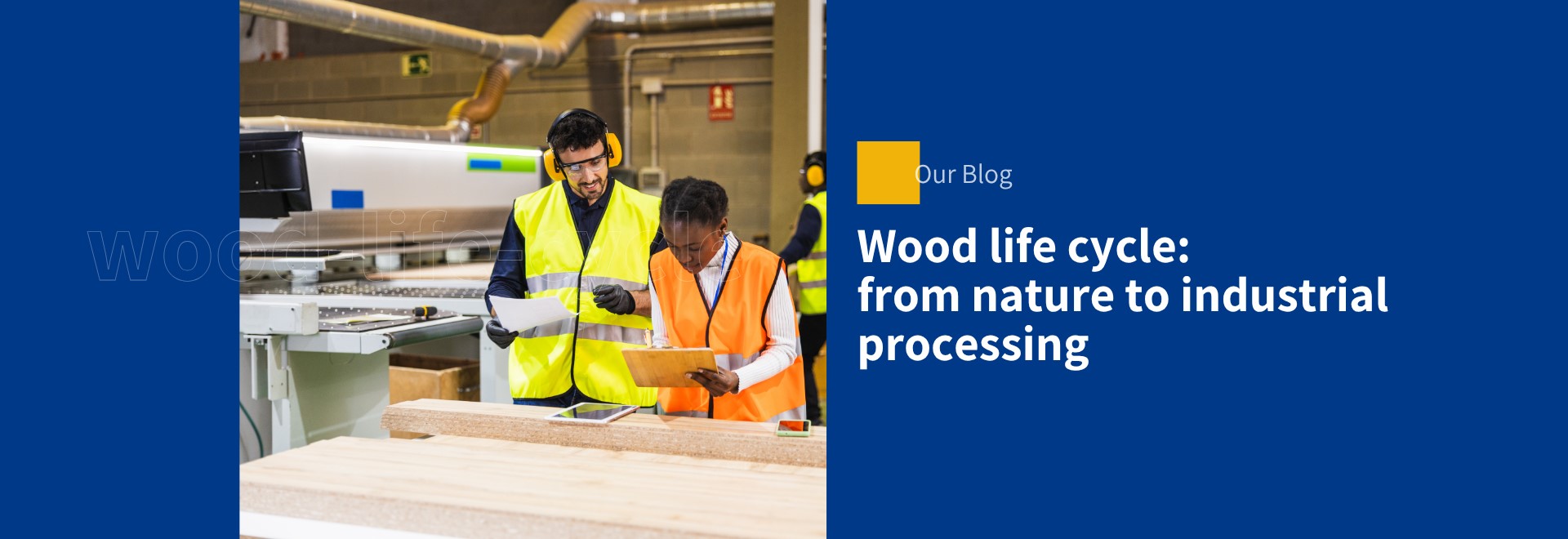
Discover the wood life cycle, from forest growth to finished products. Learn how modern technologies enhance this natural material at every stage.
Wood is one of the most widely used materials across many different industries today. Understanding the wood life cycle means entering a world of precision and attention to detail, where nature meets human ingenuity. From the growth of trees to their transformation into finished products, every stage requires knowledge, care, and specific processing technologies.
Understanding the wood life cycle also means recognizing how a natural material is created and developed—one that continues to play a central role in many production sectors, from furniture manufacturing and construction to industrial production.
In this process, wood processing plays a fundamental role. Woodworking machinery makes it possible to transform a natural raw material into precise, durable components ready to be used in a wide range of applications.
Contents
- What Is the Wood Life Cycle?
- The Main Stages of Wood Processing
- The Role of Machinery in Wood Transformation
- From Natural Material to Finished Product
- Innovation and Quality in Wood Processing
What Is the Wood Life Cycle?
The wood life cycle includes all the stages that allow a tree to become a usable material for manufacturing.
The process begins with the growth of the tree. Trees absorb carbon dioxide and water, converting them into wood fibers through photosynthesis. Over time, the trunk develops and accumulates material that can later be used to produce boards, panels, or other elements.
When the tree reaches maturity, it enters the harvesting phase. The wood is cut, transported, and taken to sawmills or processing facilities where the real industrial transformation begins.
From this point onward, the wood life cycle continues through a series of technical processes that make it possible to obtain materials ready for use in different industries.
The Main Stages of Wood Processing
After cutting and transportation, wood goes through several processing stages that transform the raw log into a usable product.
One of the first operations is sawing. During this phase, the trunk is cut into boards or elements of specific sizes. The wood is then dried to reduce its moisture content and ensure greater stability over time.
This is followed by additional processing operations such as:
- planing
- milling
- cutting and shaping
- sanding
- drilling
These processes allow manufacturers to obtain precise surfaces and components ready for the production of furniture, window frames, doors, or structural elements.
Within the wood life cycle, woodworking machinery therefore plays a crucial role in ensuring quality, precision, and production continuity.
The Role of Machinery in Wood Transformation
The wood life cycle does not only involve the natural growth of raw materials, but also their transformation through increasingly advanced technologies.
Companies that work with wood use specialized machinery designed to guarantee accurate processing. Saws, machining centers, planers, and sanders make it possible to perform complex operations with millimeter-level precision.
Thanks to technological advancements, many modern woodworking machines now integrate digital systems and advanced controls that improve the quality of the final product while also optimizing processing times.
From Natural Material to Finished Product
The final stage of the wood life cycle involves transforming the processed material into products ready for use.
Boards and components obtained during processing can be used to produce:
- furniture and interior elements
- doors and window frames
- wooden flooring
- structural components
- industrial panels and components
Wood remains one of the most versatile and appreciated materials thanks to its strength, natural aesthetics, and the possibility of being processed with great precision.
For this reason, the wood processing industry continues to evolve.
Innovation and Quality in Wood Processing
Understanding the wood life cycle helps highlight how important it is to use the right tools and machinery at every stage of processing.
Advanced and reliable technologies make it possible to obtain high-quality finished products, optimize production times, and ensure precise processing.
If you are looking for professional woodworking machinery or would like more information about the available solutions, our team is ready to assist you.
Contact us today and tell us about your needs — we will be happy to help you.

