
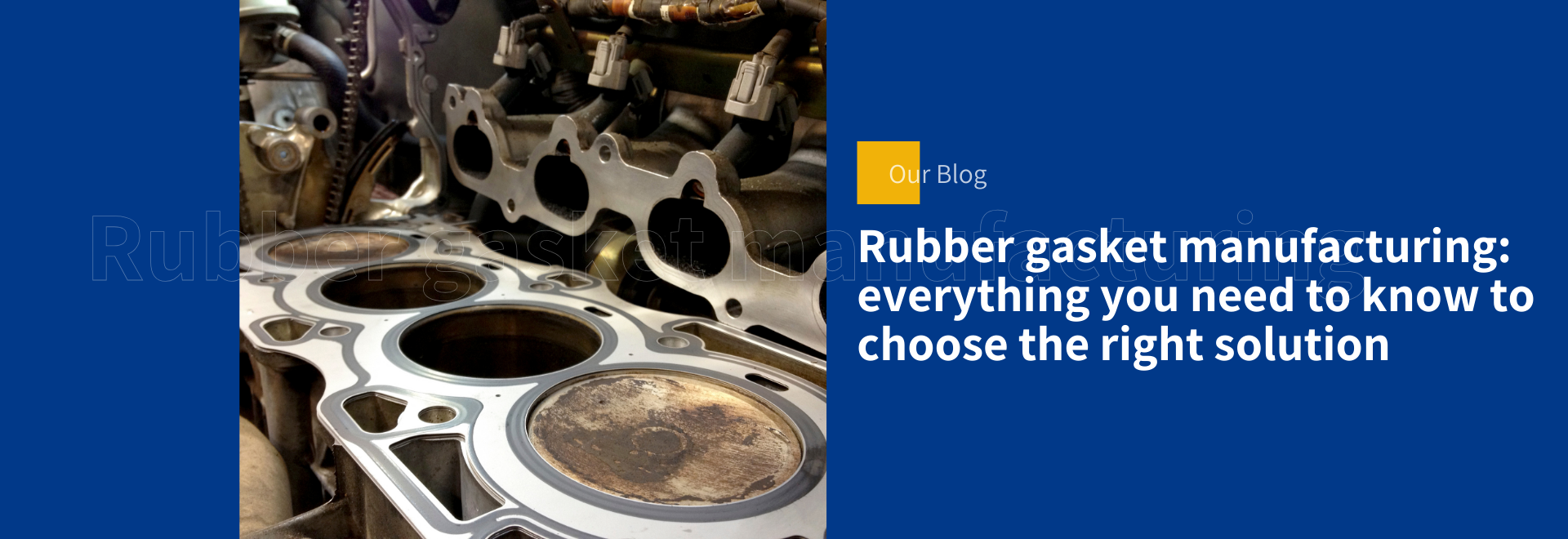
In the industrial sector, precision matters.
Especially when we talk about gaskets: small components with big responsibilities.
Rubber gasket manufacturing, and specifically rubber gasket molding, is a critical process that requires high‑quality machinery designed to guarantee performance, durability, and reliability.
For more than 50 years, Casati Macchine has been designing and producing tailored solutions for the industrial processing sector, including machinery for the production of rubber components and technical materials.
In this article, we answer the most common questions about rubber gasket manufacturing.
If you work in a manufacturing company or want to improve the productivity and quality of your department, you are in the right place.
Contents
- What is rubber gasket manufacturing?
- What are molded rubber gaskets used for?
- What are the main rubber gasket manufacturing techniques?
- Compression molding
- Transfer molding
- Injection molding
- Which materials are used for rubber gasket molding?
- What are the advantages of rubber gasket manufacturing?
- Why is choosing the right partner essential?
- Casati Macchine’s added value
What is rubber gasket manufacturing?
Rubber gasket manufacturing is a production process that makes it possible to create gaskets in different shapes and materials using dedicated molds.
The material is heated, placed inside a mold, and compressed or injected to achieve the desired shape. This process ensures precise dimensions, consistent thickness, and high performance, even under demanding conditions.
What are molded rubber gaskets used for?
Gaskets are essential components used to ensure sealing between two surfaces, prevent leaks of liquids or gases, and protect mechanical parts from dust, vibrations, or external agents.
They are used across almost every industrial sector:
- Automotive: engines, braking systems, HVAC systems
- Mechanical engineering: valves, pumps, joints
- Hydraulics and pneumatics: cylinders, fittings, distributors
- Electrotechnics: panels, connectors, junction boxes
- Food and pharmaceutical: processing and packaging systems
The rubber gasket molding process allows the production of durable, reliable, and fully customized components based on the application.
What are the main rubber gasket manufacturing techniques?
There are several technologies used in rubber gasket manufacturing, each with specific characteristics depending on production volumes, geometry complexity, and material type.
Compression molding
This is the most traditional technique. Rubber is placed inside an open mold and then compressed and heated.
Ideal for small and medium batches, simple shapes, or highly viscous materials.
Transfer molding
In this method, rubber is transferred from a compression chamber into the mold.
Perfect for complex technical parts or components with embedded metal inserts.
Injection molding
Rubber is injected directly into the closed mold.
Ideal for large‑scale production thanks to fast cycles, high precision, and reduced waste.
Which materials are used for rubber gasket molding?
Choosing the right rubber compound is essential to ensure compatibility between the gasket and the fluid or environment it will come into contact with. The most commonly used materials in rubber gasket molding include:
- NBR (Nitrile Rubber): excellent resistance to oils and fuels
- EPDM: ideal for outdoor applications, resistant to weather and aging
- Silicone: perfect for high temperatures or food‑contact applications
- Viton® (FKM): outstanding chemical and heat resistance
- Neoprene: versatile, with good mechanical strength and aging resistance
Each application requires the right material. The wrong choice can compromise sealing and lead to downtime or leaks.
What are the advantages of rubber gasket manufacturing?
Rubber gasket manufacturing offers several advantages compared to other production methods, such as sheet cutting or manual fabrication:
- High dimensional precision
- Process repeatability even at large volumes
- Complete shape customization
- Integration of metal or plastic inserts
- Optimized production times, especially with injection molding
- Reduced waste and long‑term costs
Want to reduce downtime and improve the quality of your components?
Rubber gasket molding is the ideal solution for efficient and reliable production.
Why is choosing the right partner essential?
Choosing an experienced supplier is crucial to ensure that the final product truly meets your technical and production needs. A skilled partner in rubber gasket manufacturing provides:
- Technical consulting on material selection
- Support in mold design
- Quality control at every production stage
- Production flexibility, even for small batches
Casati Macchine’s added value
Although our core business is woodworking machinery, our extensive experience in mechanical engineering has led us to work closely with companies specialized in rubber gasket molding.
We know the precision, reliability, and mechanical strength required for this type of manufacturing. And we know how to design custom systems that integrate seamlessly into each stage of production.
Conclusion
Rubber gasket manufacturing is a strategic process for companies seeking quality, efficiency, and customization in rubber component production. Whether you operate in mechanical engineering, hydraulics, automotive, or food processing, investing in a reliable, well‑designed system helps improve product performance and reduce long‑term costs.

